The holidays are the best time of the year. It is time off from work and school that you get to spend with your family and friends. Everyone has holiday traditions and special things they do this time of year. One of the most exciting things is the holiday music on the radio and in all the shops. In between the festive music, there is always time for a good audiobook!
One feel good audio that I listened to last winter was Christmas Letters by Debbie Macomber narrated by Renée Raudman. It is a festive and cozy story, perfect for this time of year.
Punk rock is a nihilistic representation of individuality and self-reliance at its most extreme, and a fun takedown of society’s conventions at the other end of the spectrum. Science is the quest for knowledge and understanding through experimentation and observation. The two are often thought of in completely separate spheres, which is funny because science was punk from the moment the first person asked, “What are those sparkly things in the sky?”
Greg Graffin is the lead singer and a songwriter in Bad Religion.
Punk is not just about being angry and rebellious. It’s about being skeptical and questioning the status quo. It’s about not taking things at face value without proof. That’s exactly what science is. Nowhere is this connection embodied better than in the lead singer of Bad Religion, Greg Graffin, who also holds a PhD in Zoology from Cornell University.
Graffin, at the age of 15, was a founding member of the band, and has been at it since 1979 aside from a short break in 1985-86. During this time he was also getting an undergraduate degree in anthropology and geology from UCLA, a master’s degree in geology also from UCLA, and ultimately his PhD. He has taught classes at both UCLA and Cornell. Continue reading When Punk Rock and Science Collide→
Tarawa atoll, Kiribati, is seen in a 2004 file photo. AP photo
A remarkable event happened late in July on a tiny island in the Pacific called Betio when the remains of thirty six U.S. Marines were flown back to the United States after being declared missing for seventy years. Among the fallen was Lt. Alexander Bonnyman, Jr., who had been posthumously awarded the Medal of Honor for leading an assault against a massive Japanese bunker. Among the team that recovered the lost gravesite was Bonnyman’s grandson, Clay Bonnyman Evans.
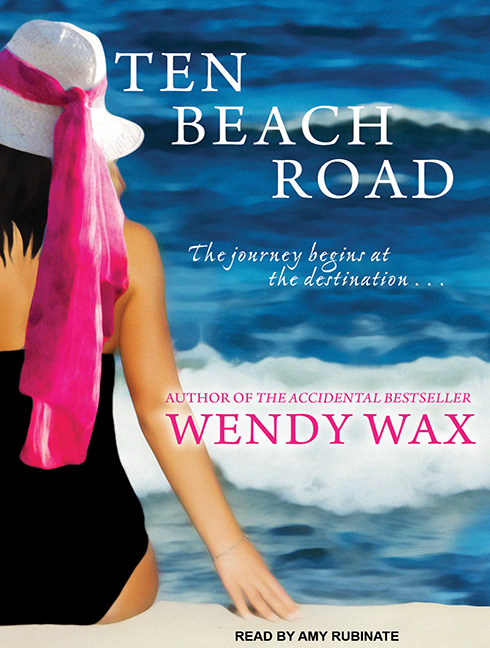
I love to travel, especially in the summer. One of the things I look forward to most on my trips is what audiobook to listen on the long car rides. While listening, you are taken to another destination. Sometimes it is fun to listen to a cozy mystery on the way up to a cabin in the woods, or Chic Lit on a girl’s trip to the beach. I like to match the theme of my trip with my audiobook. Wendy Wax’s Ten Beach Road series narrated by Amy Rubinate, is on the top of my list this summer. Ten Beach Road, Ocean Beach, andThe House on Mermaid Pointare perfect summer listens. I am also looking forward to branching out of the series and listen to A Week at the Lake, which is a USA Today bestseller.
Library Journal reviewed Ten Beach Road and said, “Wax keeps the plot twists coming and makes this great escape reading, perfect for the beach.” Publishers Weekly said Ocean Beach is “Just the right amount of suspense and drama for a beach [listen].” That sounds like something everyone can enjoy.
Where is your favorite place to travel during the summertime, and what audiobooks do you like to bring with you? Tell us and two lucky winners will be selected to win the download of their choice from our Choose Your Escape Summer Listens list! (Territory rights apply to all downloads.) Winners will be selected at random on Monday August 3rd.
I remember my very first library card. I got it when I was six years old from a bookmobile in New Bedford, Massachusetts. A new world opened to me via the public library and bookmobile. By the time I was nine, I learned that I could teach myself nearly anything from a book. My eyes were opened! Apply that today to not just libraries, but the digital world the Internet, Google, and YouTube have opened up for us.
On May 23rd and 24th I had the opportunity to witness true athleticism at the CrossFit East Regional in Hartford. “What is CrossFit?” you may be asking CrossFit is a fitness program that consists of constantly varied, high-intensity, functional movement. It takes movements we use every day and cranks it up a notch. The beauty of CrossFit is that it is scalable to every individual’s fitness level.
Every year since its inception in 2007, the CrossFit Games—which is like the Olympics of CrossFit—take place in July in Carson, CA. But first, the top forty athletes from each region must compete in the Regionals. This year there were eight regions: East, South, Atlantic, Central, West, California, Pacific, and Meridian. From there, the top five from each region will compete in the Games for the coveted title “Fittest Man and Fittest Woman on Earth.”
By Iain Martin Almighty Father, strong to save, Whose arm hath bound the restless wave, Who bidd’st the mighty ocean deep Its own appointed limits keep: O hear us when we cry to thee For those in peril on the sea. —The Navy Hymn
As we near Memorial Day our thoughts turn to those who have fallen in the service of our country. Connecticut has a long history with the U.S. Navy dating back to 1775. It was right here in Old Saybrook that the first combat submarine, Turtle, was built for use against the British Navy. Not far up the road from Old Saybrook is the town of Groton, “Submarine Capital of the World.” Groton is the home of the Electric Boat Corporation, which has been the major contractor for submarine work for the U.S. Navy since 1889. The Naval Submarine Base New London is also located in Groton as is the Navy Submarine Force Library and Museum, home to the legendary USS Nautilus (SSN-571). On a quiet side street just off the bridge over the Thames River is the U.S. Submarine World War II Veteran’s Memorial. Here one can find the names of 3,617 sailors of the submarine force who died alongside the markers commemorating the names of the fifty-two boats on which they served.
Sinking of the Lusitania. Engraving by Norman Wilkinson, the Illustrated London News, May 15, 1915. P. 631
This month marks the anniversary of one of the most tragic events of the twentieth century, the sinking of the British passenger steamer RMS Lusitania on May 7, 1915, by a German U-boat off the coast of Ireland. She had left New York on May 1 bound for Liverpool, ignoring German warnings that the seas around the United Kingdom had been declared a zone of unrestricted submarine warfare. Although international law prohibited the firing on a non-military ship without warning, the Lusitania was carrying war munitions, which the Germans claimed made her a legitimate target.
A single torpedo hit the Lusitania on the starboard side, causing a secondary explosion within the hull. It sank in eighteen minutes, killing 1,191 people, including 128 Americans. The international outcry against Germany’s attack was keenly felt in the United States, still a neutral country in 1915, and moved public opinion closer towards supporting the Allied nations against Germany. In 1917, when Germany once again launched a campaign of unrestricted submarine warfare to try and starve England into defeat, the United States declared war on Germany.
Much controversy still surrounds the sinking of the Lusitania. A succession of British governments since World War I have always denied that munitions were being transported, but in a recent declassification of documents it was shown that in 1982 the British government warned salvage divers of the presence of explosives on board. A number of British documents regarding the Lusitania remain classified.






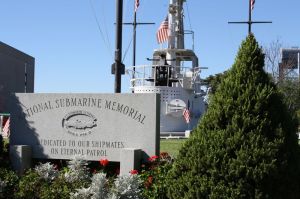 right here in Old Saybrook that the first combat submarine, Turtle, was built for use against the British Navy. Not far up the road from Old Saybrook is the town of Groton, “Submarine Capital of the World.” Groton is the home of the Electric Boat Corporation, which has been the major contractor for submarine work for the U.S. Navy since 1889. The Naval Submarine Base New London is also located in Groton as is the Navy Submarine Force Library and Museum, home to the legendary USS Nautilus (SSN-571). On a quiet side street just off the bridge over the Thames River is the U.S. Submarine World War II Veteran’s Memorial. Here one can find the names of 3,617 sailors of the submarine force who died alongside the markers commemorating the names of the fifty-two boats on which they served.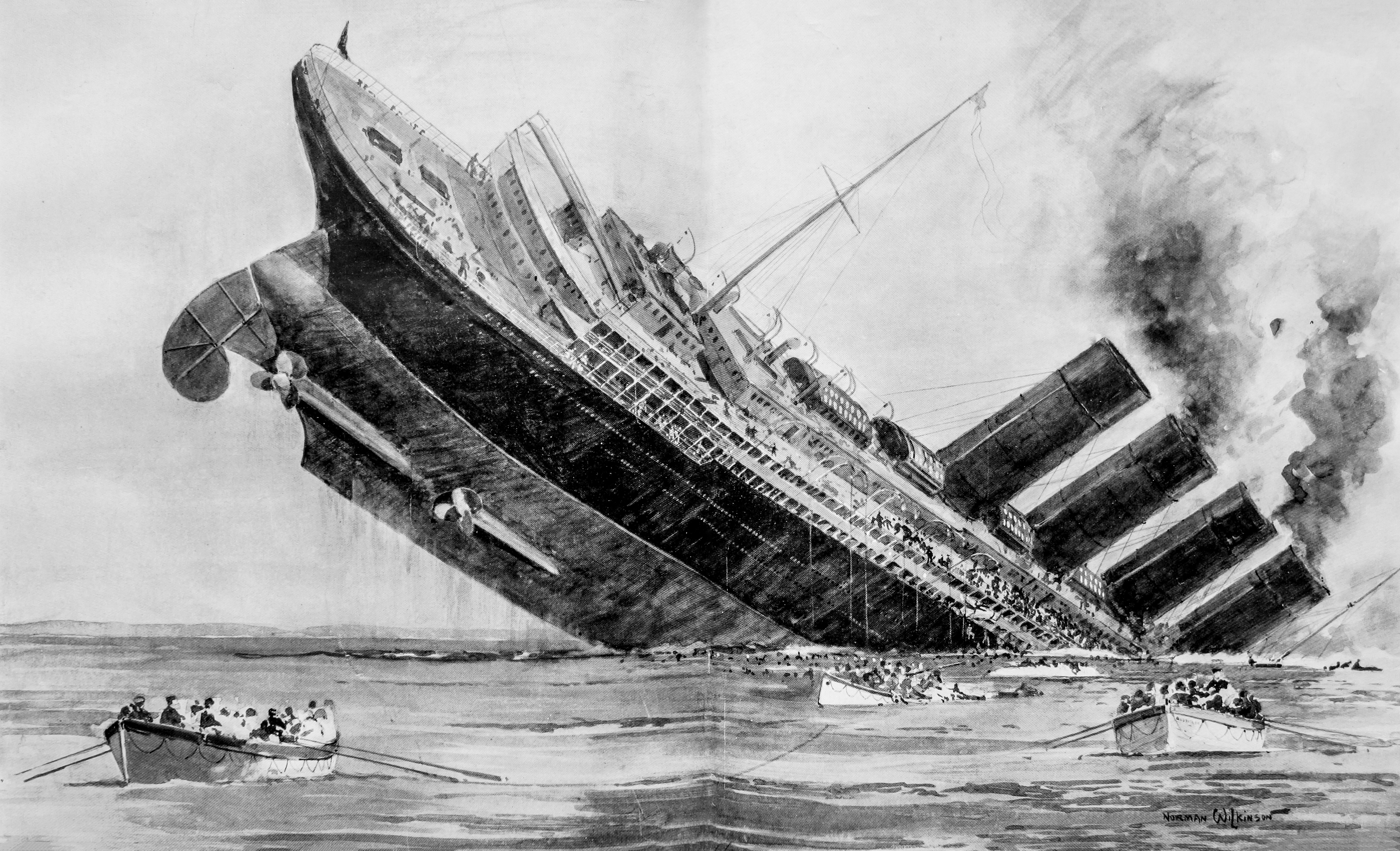
 British government warned salvage divers of the presence of explosives on board. A number of British documents regarding the Lusitania remain classified.
 Tantor Media